OLED vs LCD Phone Screen Replacement: Panel Bonding, Digitizer Separation, and Repair Cost Drivers
Compare OLED and LCD display layer stacks, isolate outer glass cracks from internal panel or digitizer faults, and evaluate replacement assembly trade-offs.
Unlike LCD, which expresses colors through liquid crystals and color filters utilizing light sources of a backlight, OLED expresses colors through RGB light-emitting materials, which are the three primary colors of light that respond to current applied to the organic light-emitting layer. Dissimilar to LCD that requires a backlight, OLED is about 30% thinner and lighter due to its simple structure.
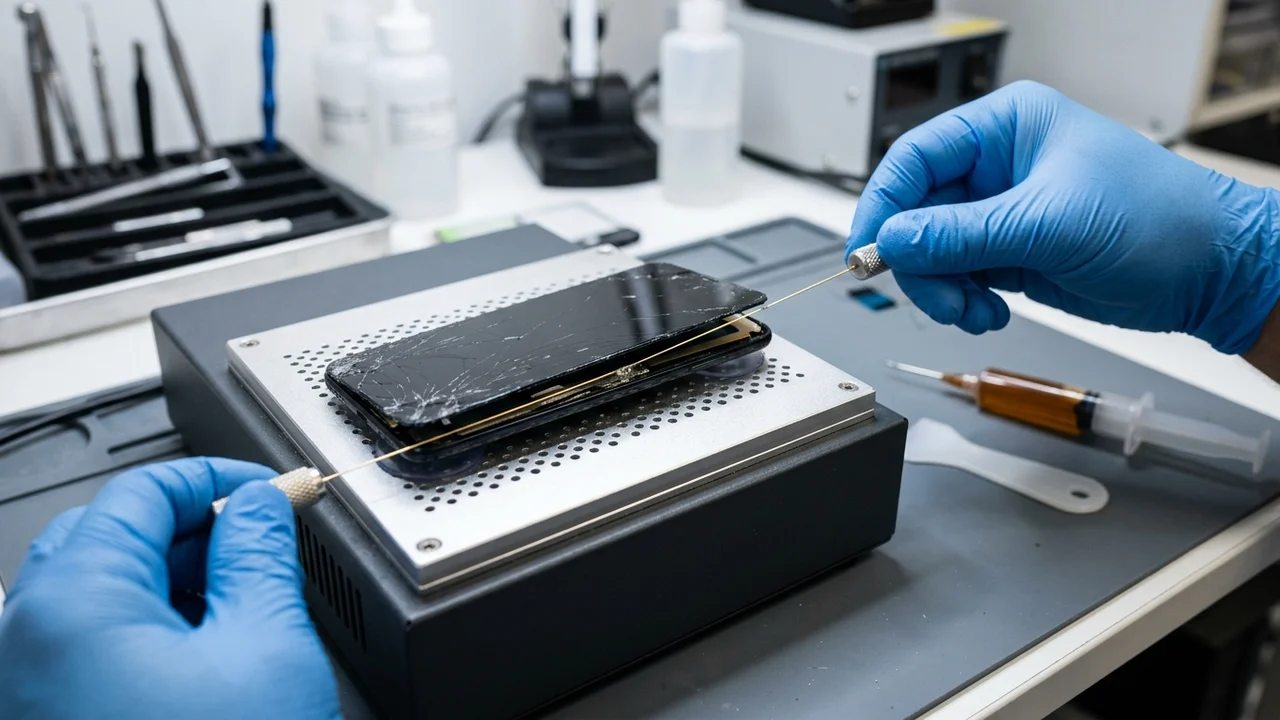
During OLED display repair, OLED screens can crack more easily if too much pressure is applied, heat needs to be applied more precisely during the repair, flex cables are often more fragile, and with some models (for example recent Samsung or iPhone devices) even a small mistake can result in lines on the display or black spots appearing on the screen. When soldering or desoldering lithium-polymer battery wires, drain the battery below 25% to reduce the battery's ability to start a fire if it was short-circuited.
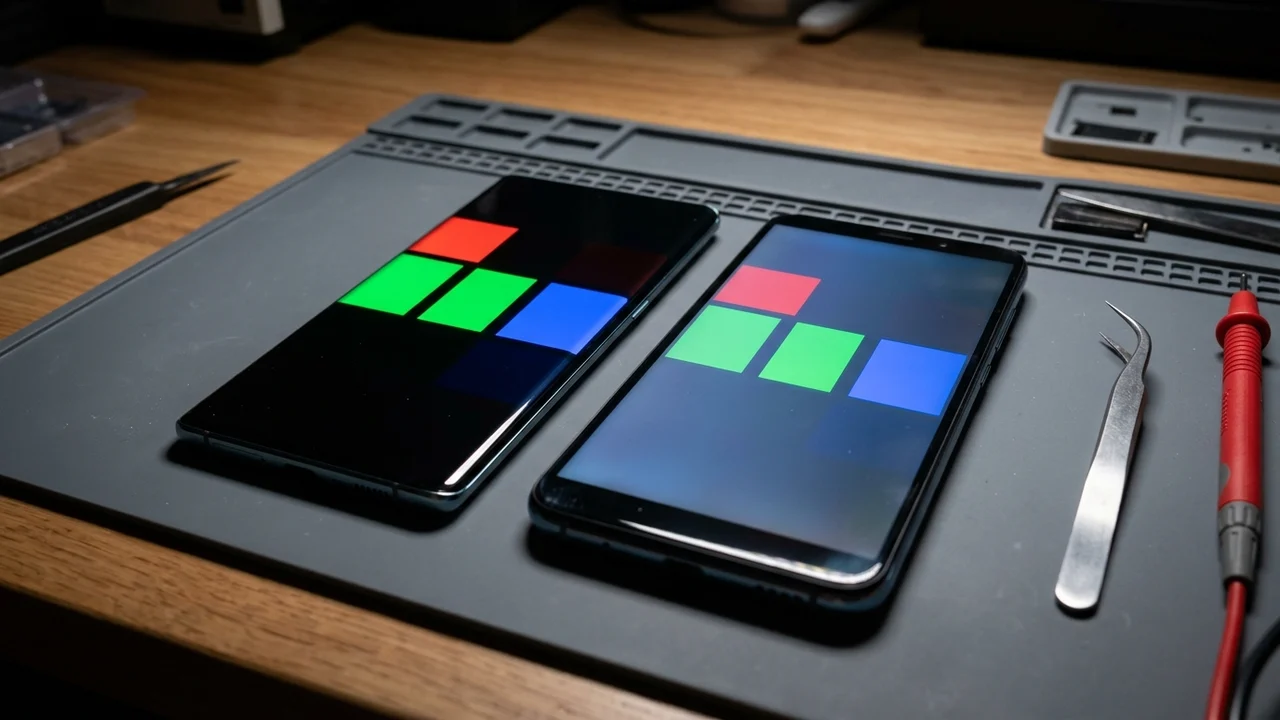
Handset display baseline comparison
| Handset Model | Display Type & Resolution | Contrast & Brightness |
|---|---|---|
| iPhone 11 | Liquid Retina HD 6.1-inch (diagonal) all-screen LCD Multi-Touch display with IPS technology, 1792-by-828-pixel resolution at 326 ppi, True Tone, Wide color (P3), and Haptic Touch | 1400:1 contrast ratio (typical) and 625 nits max brightness (typical) |
| iPhone 12 | Super Retina XDR 6.1-inch (diagonal) all-screen OLED display, 2532-by-1170-pixel resolution at 460 ppi, HDR, True Tone, Wide color (P3), and Haptic Touch | 2,000,000:1 contrast ratio (typical), 625 nits max brightness (typical), and 1200 nits peak brightness (HDR) |
| iPhone 15 Pro | Super Retina XDR 6.1-inch (diagonal) all-screen OLED display, 2556-by-1179-pixel resolution at 460 ppi, Dynamic Island, Always-On display, and ProMotion technology with adaptive refresh rates up to 120Hz | 2,000,000:1 contrast ratio (typical), 1000 nits max brightness (typical), 1600 nits peak brightness (HDR), and 2000 nits peak brightness (outdoor) |
| Pixel 11 Pro XL | 6.8-inch (171 mm) Super Actua LTPO OLED display, 20:9 aspect ratio, 1344 x 2992 at 486 PPI, Smooth Display (1-120 Hz), and Corning Gorilla Glass Victus 2 cover glass with anti-scratch shield | >2,000,000:1 contrast ratio, up to 2400 nits (HDR), and up to 3600 nits (peak brightness) |
The iPhone 11 has a width of 2.98 inches (75.7 mm), a height of 5.94 inches (150.9 mm), a depth of 0.33 inch (8.3 mm), and a weight of 6.84 ounces (194 grams). The iPhone 12 has a width of 2.82 inches (71.5 mm), a height of 5.78 inches (146.7 mm), a depth of 0.29 inch (7.4 mm), and a weight of 5.78 ounces (164 grams).
Layer-by-layer stackup: IPS LCD, rigid OLED, and Y-OCTA flexible OLED
In Samsung OLED mobile panels, a wide color gamut equivalent to 120% DCI-P3 is paired with high brightness and low reflectance of 1,500 cd/m2 or more. Because Samsung OLED implements Real Black of less than 0.0005 nit, the contrast ratio is close to infinity. Samsung OLED achieves a contrast ratio of 1,000,000:1 or higher for realizing High Dynamic Range (HDR). Samsung OLED also supports a high refresh rate of 240Hz and has a response speed of about 1.5 times faster than LCD.
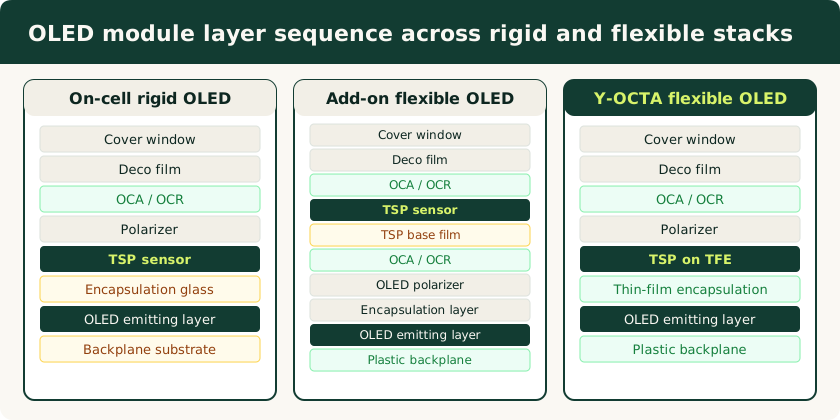
A traditional rigid OLED panel itself has two glass substrates—the encapsulation glass and the substrate glass on the backplane—with a seal made of frit or resin between the encapsulation and backplane glass for encapsulation, and the touch-sensor panel (TSP) sensor on the surface of the encapsulation glass. Overall, an on-cell rigid OLED module has eight layers, including touch and cover window, from top to bottom: cover window, deco film, OCA/OCR, polarizer, TSP sensor, encapsulation glass, OLED emitting layer, and backplane substrate. In an in-cell rigid OLED module, the eight layers remain unchanged, but from top to bottom the layers comprise: cover window, deco film, OCA/OCR, polarizer, encapsulation glass, TSP sensor, OLED emitting layer, and backplane substrate.
Flexible OLED is a flexible panel completed by applying a flexible polyimide (PI) substrate and TEF technology; unlike glass, which is difficult to process, PI can be made much thinner, thereby reducing the overall weight. A flexible OLED is based on a flexible substrate (usually polyimide), and plastic-based mobile OLED displays are lighter, thinner, and more durable compared to glass-based displays.
Owing to the addition of the TSP base film, a flexible OLED display with a separate plastic TSP base film has 10 layers from top to bottom: cover window, deco film, OCA/OCR, TSP sensor, TSP base film, OCA/OCR, OLED polarizer, encapsulation layer, OLED emitting layer, and backplane plastic substrate. In Samsung Display Y-OCTA flexible OLED, the eight layers from top to bottom are in this order: cover window, deco film, OCA/OCR, polarizer, TSP on thin-film encapsulation, thin-film encapsulation, OLED emitting layer, and plastic substrate backplane.
Dymax optical display laminating adhesives help reduce air entrapment and bubbles to create strong, ripple-free bonds that help increase panel strength, and they also act as a barrier against stressing, significantly improving product reliability and warranty costs.
Fault isolation: outer glass separation vs full display assembly replacement
Before disassembling a handset, run the checks in the smartphone hardware diagnostics overview.
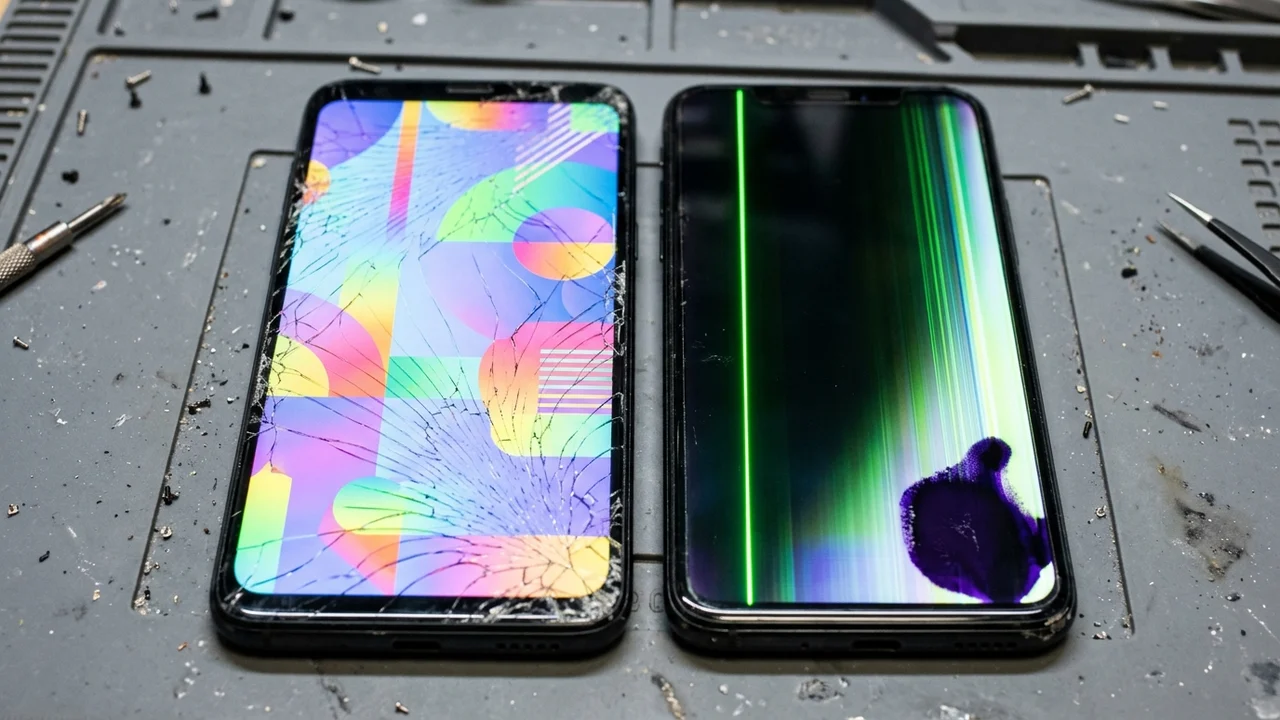
Apple documents that on nongenuine iPhone displays, Multi-Touch might not respond on parts of the screen, Multi-Touch performance might be degraded (such as missed screen touches or touches not registering in the right location), touches might unexpectedly register during a phone call, the display might not turn off during phone calls, and accidental edge or palm touches might register.
According to DXOMARK, OLED displays and LCDs show PWM at different frequency ranges—the PWM of OLED displays ranges from ~50 to ~500 Hz, whereas the PWM of LCDs starts at around 1000 Hz or higher—and as the human eye may experience flicker sensitivity up to about 250 Hz (at least for most people), OLED displays are more likely to cause eyestrain than LCDs. When a display adjusts to its minimum brightness in very dim or completely dark ambient light conditions, the duty cycle is very short and the interval when the diode is off is proportionately much longer (for example, minimum brightness may translate to a 10% duty cycle, meaning that the diode is off for 90% of the period). In DXOMARK flicker graph testing, the first spike appears at a phone’s listed refresh rate, but the highest spike (the one that comes closest to or surpasses 0 dB) indicates the PWM frequency: 241 Hz for the Samsung (S20), 362 Hz for the Huawei, 481 Hz for the OnePlus, and 240 Hz for the other Samsung (Note20).
Electrical and battery risks of downgrading an OLED phone to an aftermarket LCD
The Texas Instruments TPS65632 triple-output AMOLED display power supply consists of two boost converters and an inverting buck-boost converter, where the VPOS output is fixed at 4.6 V, VNEG is programmable via a digital interface in the range of -1.4 V to -5.4 V (the default is -4 V), and AVDD can be selected between 7.7 V and 5.8 V using the SELP2 pin. The TPS65632 operates from a 2.9-V to 4.5-V input voltage range to drive AMOLED displays requiring three supply rails (VPOS, VNEG, and AVDD), with Boost Converter 1 (VPOS) delivering a 4.6-V output voltage with 0.5% accuracy (25°C to 85°C) and 300-mA output current. During normal operation of the TPS65632, an error condition is detected if VPOS falls below 4.1 V for longer than 3 ms or VNEG is pulled above the programmed nominal output by 500 mV for longer than 3 ms; in either case the device goes into shutdown and the outputs are disconnected from the input. Similarly, the Texas Instruments TPS65631 dual-output AMOLED power supply consists of a boost converter and an inverting buck-boost converter, where the VPOS output is fixed at 4.6 V and the VNEG output is programmable via a digital interface in the range of -1.4 V to -4.4 V (the default is -4 V).
The Texas Instruments TPS61165 is a high-efficiency, high-output-voltage boost converter in a small package size ideal for driving white LEDs in series; the device integrates a 40-V/1.2-A switch FET and operates in pulse width modulation (PWM) with a 1.2-MHz fixed switching frequency. For instance, in the TPS61165 datasheet when VIN is 3 V, 8 LEDs output equivalent to VOUT of 26 V, the inductor is 22 μH, the Schottky forward voltage is 0.2 V, and the maximum output current is 110 mA in typical condition; when VIN is 5 V, 10 LEDs output equivalent to VOUT of 32 V, the inductor is 22 μH, the Schottky forward voltage is 0.2 V, and the maximum output current is 150 mA in typical condition. For board-level supply faults, see the motherboard PMIC short-circuit and BGA diagnostics guide.
By applying the Dark mode UI to Samsung OLED, the On Pixel Ratio among all pixels can be significantly reduced, reducing power consumption by about 25% (based on laptops). Samsung Adaptive Frequency automatically adjusts the display refresh rate from 10 Hz to 120 Hz depending on the consumer’s usage environment; by supporting variable refresh rates, such as 120 Hz for games with fast screen switching and 10 Hz for still images, the panel driving power can be reduced by up to 22% compared to the existing ones. On iPhone models with Always-On display, the display automatically turns off when iPhone is either face down or obstructed from view, not near a paired Apple Watch, when a CarPlay session begins, while Continuity Camera is in use, while Low Power Mode is on, while Sleep Focus is on, or at your usual bedtime. For charging current and temperature checks, see the slow-charging amperage and thermal throttling guide.
Replacement part tiers, calibration locks, and repair cost drivers
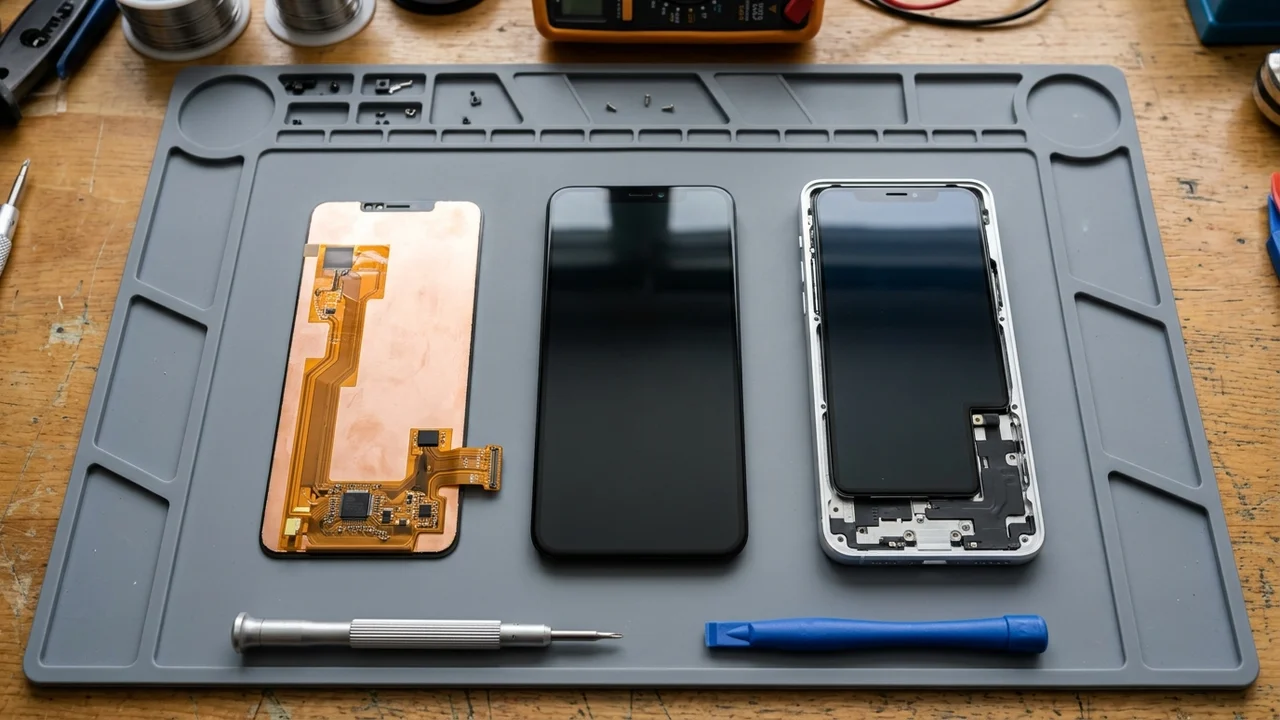
Apple states that on nongenuine iPhone displays, True Tone display might not work correctly, ambient light sensor performance might be lost or degraded (causing the screen to dim or brighten incorrectly), display color calibration might be incorrect (causing, for example, the display to appear too yellow or blue), the display might not be uniformly bright, maximum brightness might be lower, and the battery might drain unintentionally.
Apple warns that repairs performed by untrained individuals using nongenuine parts might affect the safety of the device or functionality of the display, and repairs that don’t properly replace screws or cowlings might leave behind loose parts that could damage the battery, cause overheating, or result in injury.
Outer glass refurbishing vs full display assembly decision matrix
| Replacement Option or Check | Verified Specification & Scope |
|---|---|
| Aftermarket Hard OLED vs Soft OLED | Hard OLEDs have a more limited viewable area, are thicker than soft OLED, cannot extend all the way to the edge of a screen, and are more likely to be damaged by a drop or during repair and replacement due to their hard glass backing |
| Aftermarket LCD for iPhone X, XS, and XS Max | In iFixit’s comparison for iPhone X, XS, and XS Max, these LCDs (and their Fix Kits) are less than half the price of the OLED models iFixit sells, are a little darker (about 50 nits worth), have a little lower resolution, and the colors and contrast ratio will not be quite the same |
| iPhone Parts and Service History path | With iOS 15.2 and later, open Settings, tap General, and then tap About; if your iPhone has been repaired, you will see a Parts and Service History section in the About screen |
| Apple Repair Assistant calibration | Genuine Apple parts are individually calibrated with data uploaded to Apple’s servers and stored at the time of manufacture, and this data is then retrieved to finish the repair; in Parts and Service History, your device will show Finish Repair next to the part until you finish the repair with Repair Assistant |
| Google Pixel genuine spare parts | If you want to fix your Pixel device, you can buy genuine Google parts from iFixit, which also provides step-by-step repair guides and tools for Pixel 2 and later phones |
| Google Pixel downloadable repair manuals | You can get repair manuals in English and French for Pixel 6a and newer phones |
Sources
- Samsung Display — OLED Display Technology
- Display Daily / IHS Markit — So What is Y-OCTA?
- OLED-Info — Flexible OLEDs: Introduction and Market Status
- Intertronics — Dymax Optical Display and Touch Screen Laminating Adhesives
- Apple Support — About genuine iPhone displays
- Apple Support — iPhone Parts and Service History
- Apple Support — Keep the iPhone display on longer (Always-On display)
- Apple Support — iPhone Technical Specifications
- Google Support — Pixel Phone Hardware Tech Specs
- Google Support — Repair Your Own Pixel Device
- Texas Instruments — AMOLED Display Power Supply and White LED Driver Datasheets
- DXOMARK — Flicker, the display affliction
- iFixit — Tested LCDs and OLED Screens Comparison and Soldering Safety Guide
- Foneday — OLED vs LCD screen repair
Related Technical Guides
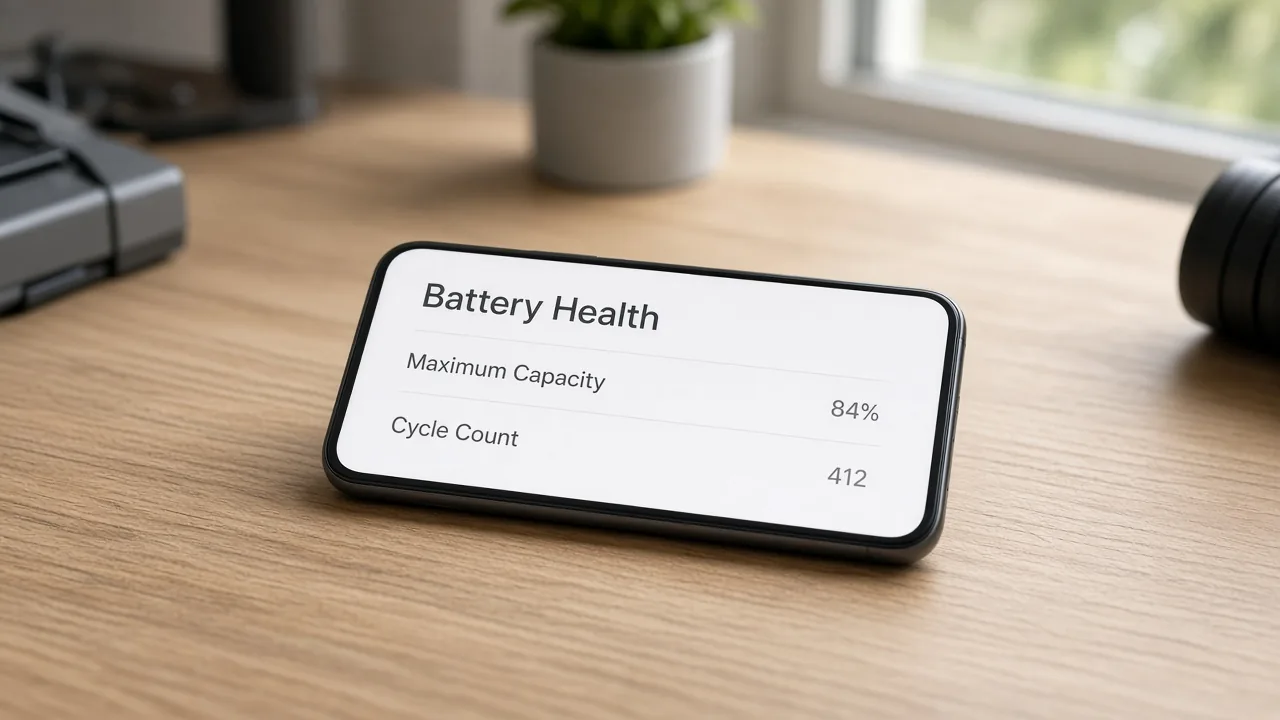
Phone Battery Health and Cycle Count Diagnostics: Coulomb Counter Drift, Internal Resistance, and 80% Cutoff
Phone battery health is a capacity ratio. Read cycle count, fuel-gauge drift, and resistance shutdowns before an 80% capacity cutoff.
Read technical guide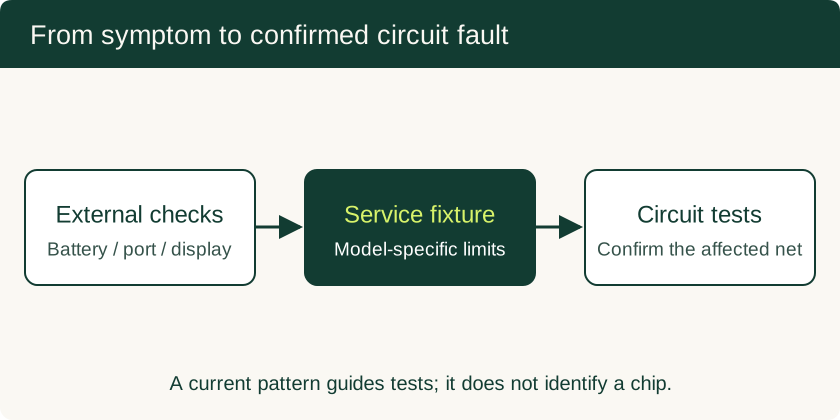
Phone Motherboard Repair: PMIC Diagnosis, BGA Rework and Data Recovery
Understand how technicians narrow down board faults, what BGA rework involves, and which repair decisions preserve the chance of local data recovery.
Read technical guide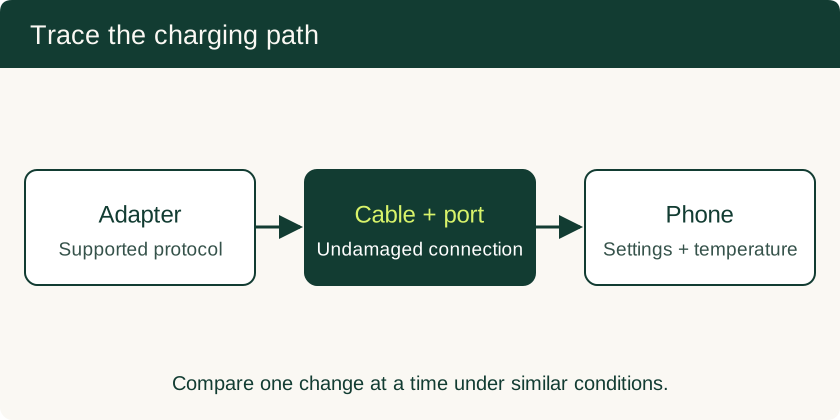
Why Is My Phone Charging Slowly? Six Checks for Cables, Current and Heat
Separate charger and cable faults from battery taper, charge limits and temperature protection with a six-step charging check.
Read technical guide